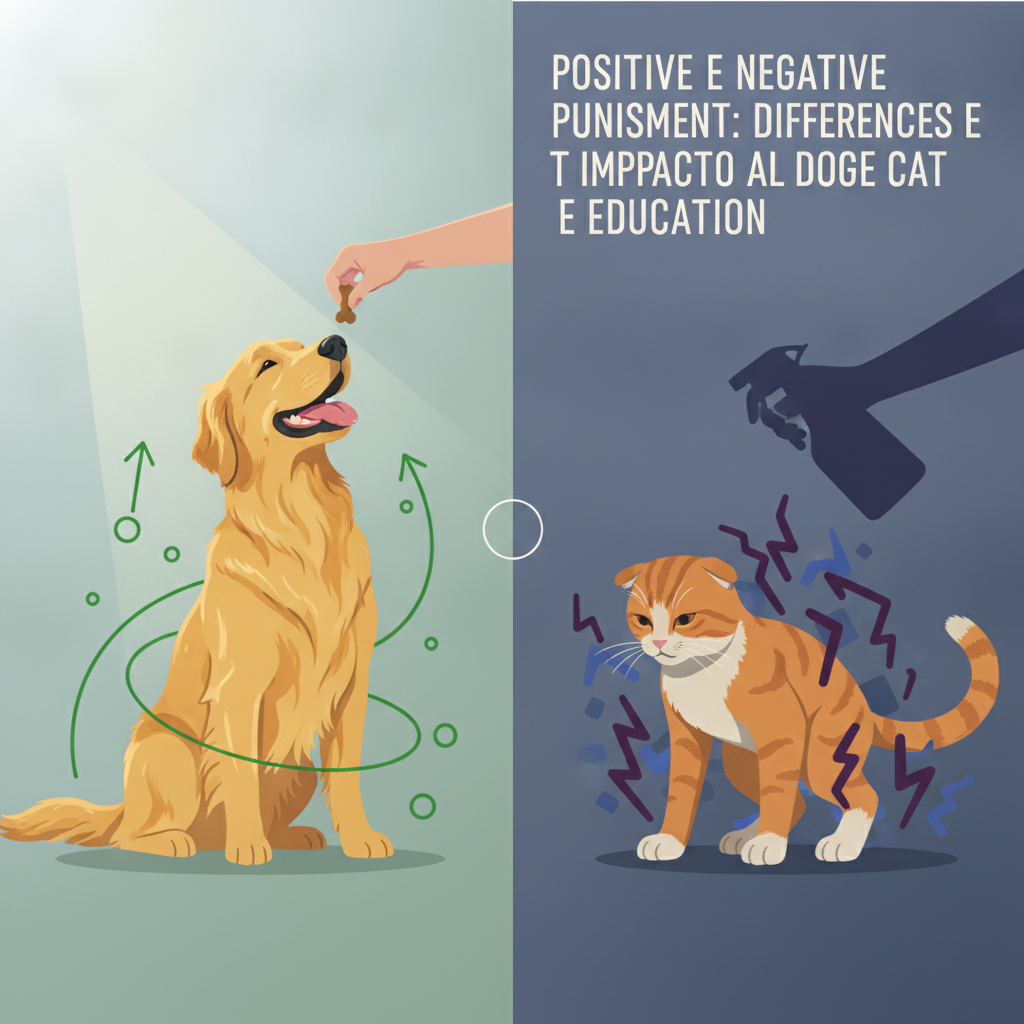
Positive and Negative Punishment: Differences and Impact on Dog and Cat Education
The education of dogs and cats is a rich theme in methods and philosophies, and few aspects generate as much confusion and debate as the use of punishment. Many tutors find themselves lost, seeking the best way to correct unwanted behaviors without harming their companions. After all, what does it really mean “positive punishment” or “negative punishment”?How do they work in practice and, more importantly, what is their real impact on emotional health and learning of our pets?
Unraveling the Concepts: Positive Punishment and Negative Punishment
To understand punishment in animal education, it is crucial to disassociate ourselves from common sense and embrace the technical definition of behavioral psychology, specifically operant conditioning. In this context, “positive” does not mean “bom”, and “negative” does not mean “ruim”. On the contrary, they refer to mathematical operations:
- Positive (+): It means adding or presenting something.
- Negative (-): It means removing or subtracting something.
The word “punishment” has an invariable meaning: it is any consequence that decreases probability a behavior to be repeated in the future.
Positive Punishment: Adding Something Nasty
Positive punishment occurs when an aversive stimulus is added the environment after an unwanted behavior, in order to reduce the occurrence of this behavior. The animal associates the discomfort or aversion directly to what he did.
- Examples in dogs:
- Tugging at the guide (or wearing a shock collar, hanger, etc.) when the dog pulls.
- Spray water on the dog's muzzle when it barks excessively to the doorbell.
- A strong and imposing“no”, a knock on the table or a loud noise to stop an unwanted growl.
- Examples in cats:
- Spray water when the cat jumps on the kitchen counter.
- A shout or a light slap (even if with newspaper) when the cat scratches a piece of furniture that should not.
- Use a can with coins to make loud noise when the cat bites during play.
In all these cases, an unpleasant stimulus is introduced to suppress a behavior.
Negative Punishment: Removing Something Desirable
Negative punishment occurs when a stimulus or resource that the animal desires is removed the environment immediately after an unwanted behavior, with the aim of decreasing the repetition of that behavior.
- Examples in dogs:
- Turn your back and stop interacting (remove attention) when the dog jumps on people to greet.
- Remove the toy from the scene (remove feature) when the dog bites your hand too hard during play.
- Stop a walk (remove pleasurable activity) for a few seconds when the dog incessantly pulls the guide.
- Examples in cats:
- Stop play (remove pleasurable activity) and move away when the cat attacks the hands or feet of the guardian.
- Remove access to food or treats (remove feature) if the cat tries to steal food from the table.
- Ignore excessive meowing for attention (remove attention) until the cat calms down.
In these scenarios, something good is taken away to decrease the chance of the behavior occurring again.
The Impact of Positive Punishment: Risks, Consequences, and Why to Avoid
Positive punishment, while it may seem effective at suppressing unwanted behavior quickly, carries with it a number of serious risks and negative consequences for your pet's mental health and well-being.
Common Negative Consequences:
- Fear and Anxiety: Punishment often causes fear and anxiety. The animal not only associates the aversive stimulus with behavior, but also with context (environment), other present stimuli, and, crucially, with the person who applies the punishment.
- Agitation and Aggression: An animal that feels threatened or constantly punished may react with aggression (out of fear or frustration) as a form of self-defense.
- Inhibition and Impotence Learning: Punishing too much or inconsistently can lead the animal to a state of inhibition, where it stops trying any behavior for fear of doing something “errado”, which can evolve into the “impotence learnt”, where the animal gives up trying to influence its environment.
- Maladaptive Generalization: The animal may generalize aversion not only to specific behavior, but to situations, people or similar objects.For example, a dog punished for barking at visitors may become afraid of all new people.
- Suppression of Behavior Instead of Resolution: Punishment usually suppresses the symptom (the unwanted behavior) but does not address the underlying cause. A dog that barks for separation anxiety, if punished, may stop barking, but the anxiety persists and may manifest in other ways (destruction, self-harm).
- Damage to the Tutor-Pet Relationship: The basis of a healthy relationship is trust and respect. Frequent punishment destroys this basis, causing the pet to associate the guardian with unpleasant events.
- Risk of Physical Injury: Positive punishment tools, such as shock collars, hangers, or direct physicals, can cause injuries to the windpipe, neck, and spine, as well as psychological stress.
When (And If) Would It Be Considered?
In a purely technical context and in situations of imminent risk to life (for example, a dog that is about to attack a child and needs to be stopped immediately to avoid a fatality), a high-intensity aversive stimulus could be used by an experienced and certified professional to interrupt critical behavior. However, it is essential to understand that this is a very rare exception and always followed by interventions to treat the cause of the behavior and teach alternatives. For the common tutor, positive punishment is almost always contraindicated and should be avoided.
Negative Punishment: A Safer Approach, But With Resalts
Negative punishment is generally considered a more ethical and less harmful alternative than positive punishment, as it does not involve adding a direct aversive stimulus.
Advantages of Negative Punishment:
- Lower Risk of Emotional Damage: By removing a resource or attention, the tutor avoids causing physical pain or intense fear.Frustration, while present, is more manageable and less traumatizing than pain or fright.
- Preservation of the Bond: Since the tutor is not the direct source of an aversive stimulus, the risk of damaging the bond is significantly lower. The animal learns that the unwanted behavior leads to the loss of something good, and not that the tutor is “ruim”.
- Focus on Natural Consequence: Many examples of negative punishment (such as stopping play when there are excessive bites) simulate natural consequences that the animal would encounter in interactions with others of its species.
Challenges and Resalves:
- Demands Consistency: To be effective, the removal of the stimulus must be immediate and consistent. Any inconsistency can confuse the animal and decrease the effectiveness.
- May Cause Frustration: While less damaging than fear, frustration can lead to other unwanted behaviors, such as barking, meowing, or more persistent attempts to get what they want.
- Inadequate for Compulsive or Fearful Behaviors: If a behavior is driven by anxiety, fear, or compulsion, negative punishment (or any punishment) will not resolve the root cause and may even worsen the emotional state of the animal.
Practical example: If your dog jumps on you when you get home.
Positive Punishment: You push him, step on his paw, or give him a “no” high. He may stop jumping at the moment, but may associate his arrival with something unpleasant, or jump on other people to test.
Negative Punishment: You turn your back immediately, ignoring him completely until he is with all four legs on the ground. At the slightest sign of calm, you reward him. He learns that jumping makes you move away, while calm brings your attention and affection.
More Effective Paths: The Power of Positive Reinforcement and Constructive Strategies
As an expert, my duty is to guide tutors to the most effective and ethical approaches.It is almost impossible to speak of punishment without contrasting it with reinforcement, especially positive reinforcement, which is widely recognized as the cornerstone of humanitarian and effective animal training.
Positive Reinforcement: Where Good Behavior Flowers
Positive reinforcement involves add something that the animal likes (a snack, affection, toy, praise) immediately after a desired behavior, increasing the likelihood that this behavior will repeat.It is the basis for building new behaviors and strengthening existing ones.It creates a positive association with learning and with the tutor.
- Example: Dog sits when asked & wins a treat and praise.He will learn that sitting is rewarding.
- Example: Cat uses the scratching post & gets a treat and is praised.He will learn to prefer the scratching post.
Constructive Strategies Instead of Punishment:
When faced with unwanted behavior, the first question should be: “WHAT do I want my pet to do *instead*?” and “Why is he doing this?”.
- Environmental Management: The simplest way to correct” many behaviors is to prevent them from happening. If the cat climbs on the counter, remove attractive items or cover the counter with foil (an unpleasant but harmless surface) until it loses interest. If the dog gnaws shoes, put away the shoes.
- Teaching Alternative Behaviors: Instead of punishing a jumping dog, teach him to sit down to greet him. Reward him generously for sitting down.
- Redirection: If the cat scratches the sofa, redirect it to the scratching post.When he uses it, reward him.
- Identification and Treatment of the Root Cause: Problematic behaviors (excessive barking, peeing outside the box, aggression) are often symptoms of larger problems like anxiety, fear, pain, or lack of stimulation.Punishment only masks the problem.
- Patience and Consistency: No method works without these two pillars.Education is an ongoing process.
Decision Criteria, Common Errors, and When to Seek Professional Help
The choice of how to approach the behavior of your pet directly impacts on the quality of life and your relationship.The following are criteria, common mistakes and when to seek support.
Criteria for Assessing Your Approach:
- The Emotional Health of Pet: Does your pet look happy, confident and safe next to you? Or does it show signs of stress (back ears, tail between legs, excessive yawning, lip licking, wide eyes, tremors, avoidance).
- The Tutor-Pet Link: Do you feel that the relationship is strengthening or deteriorating?Your pet seeks your company and affection freely?
- Long-term Effectiveness: Has unwanted behavior actually decreased consistently? Or has it just been temporarily suppressed, resurfacing in other forms or contexts.
- Understanding the Pet: Does your pet understand what you want him to do, or is he just trying to avoid something unpleasant?He knows what the “certo” behavior is?
- Your Own Emotional Response: Are you applying the method calmly and objectively, or with anger and frustration? Negative emotions from the tutor rarely lead to positive results in training.
Common Errors in the Application of Punishment (especially the positive one):
- Incorrect Temporality: Punishment needs to be immediate (within 1-3 seconds) for the animal to associate the consequence with the behavior. Punishing a dog for a pee made minutes ago is ineffective and unfair.
- Inconsistency: Punishing sometimes and ignoring others confuses the animal and reinforces the behavior intermittently, making it more resistant to extinction.
- Inadequate Intensity: A very mild punishment may have no effect; a very severe one can be traumatizing and cause the aforementioned side effects.
- Focus Only on Unwanted Behavior: Punishing without teaching and reinforcing an appropriate alternative behavior is like saying “Don't do this!” without saying “Do that!”.
- Personalization of Punishment: View punishment as “vengean” or express anger.Punishment should be an objective process, not an emotional one.
When to Seek Professional Help:
If you feel overwhelmed, frustrated, or if your pet's behavior is getting worse or aggressive, it's time to seek help.Skilled professionals can offer a safe and effective management and training plan: a
- Veterinary Doctor: To rule out any medical cause for the behavior (pain, hormonal imbalance, diseases).
- Veterinary Behavioralist (Zootecnist or Veterinarian specializing in behavior): Professional with training in veterinary medicine and postgraduate in ethology/animal behavior.It is the most suitable for complex cases, aggression or severe anxiety problems, as it can diagnose and clinically treat the animal.
- Positive Trainer/Animal Behavior Consultant Certificate: A professional experienced in positive reinforcement methods, who can teach training techniques and environmental management, and assist in building a good relationship.Make sure that the professional does not use aversive positive punishment methods.
Seek recommendations, check credentials, and make sure the philosophy of the practitioner is aligned with animal welfare principles and methods without coercion or pain.
Frequently Asked Questions About Punishment and Animal Education
- “My dog does not obey me if I am not firm. A scream is not positive punishment?”
- Yes, a loud cry or a “no” imposed with the intention of scaring or causing discomfort to stop a behavior is a form of positive punishment. Although it can stop the behavior momentarily, it can erode trust, make the dog associate its voice with something unpleasant or even make it more resistant to you in the long run. Positive reinforcement methods teach the dog what to do, not what not to do out of fear.
- “My cat scratches the furniture. Spraying water is the only way to make it stop?”
- Spraying water is a form of positive punishment. Although it can interrupt the scratch at the moment, the cat can learn to scratch when you are not around, or associate the water with you, decreasing confidence. The most effective approach is to offer suitable and attractive alternatives (scratchers of different types, vertical and horizontal), use feline pheromones to reduce stress and make furniture less attractive (with double-sided ribbons or temporarily covering them), and reward the use of the scratching device.
- “If I ignore my dog when he jumps, is that not bad for him?”
- Ignore (turn your back, remove attention) when the dog jumps is an effective example of negative punishment. It is not “ruim” for him, provided that it is applied consistently and that you immediately reward the desired alternative behavior (eg, the four legs on the ground). He will learn that jumping does not bring what he wants (his attention), but calm yes. It is a form of clear and not aversive communication.
- “When should I use positive punishment in case of extreme need?”
- As a general rule, tutors should avoid aversive positive punishment in any circumstance. Even in situations of “extrema need” (such as avoiding an imminent attack), the intervention should be performed by a qualified professional, who can apply an effective interruption with minimal harm and, crucially, immediately start a management plan and behavior modification. Positive punishment at the hands of an inexperienced tutor can easily lead to escalations of aggression, emotional and physical harm, and rupture of the bond. The focus should always be on prevention, management and teaching of alternative behaviors through positive reinforcement.
In short, the education of dogs and cats is a journey of partnership and mutual understanding.The definitions of positive and negative punishment are clear in behavioral theory, but their practical implications require careful and ethical analysis. As responsible tutors, our role is to choose methods that not only modify behavior, but also cultivate an environment of safety, trust and joy for our animals, always prioritizing positive reinforcement and lasting well-being.