Scratch in cats: behavioral management
Does your cat insist on scratching furniture and carpets? Understand why he does this and learn effective strategies to redirect this natural behavior to appropriate locations.
The Essence of Feline Scratch: More Than Sharp Nails
Scratching is an instinctive, multifaceted behavior and absolutely essential for the physical and mental health of cats. Far from being an act of rebellion or “disobedience”, scratching is part of feline nature itself, performing several vital functions that every tutor needs to understand for effective behavioral management. Ignoring or attempting to suppress this natural behavior is counterproductive and can lead to stress and anxiety problems for the animal.
First, scratching serves as a crucial maintenance of claws.Cats have retractable claws that grow continuously. When scratching, they remove the outer and old layers, revealing the new and sharp claws underneath.It is like a natural manicure ritual that prevents the nails from overgrowth and causing discomfort or pain. Without this removal, the claws can jam or hinder locomotion.
In addition to hygiene, scratching is a powerful form of territory marking.Cats' paws harbor odoriferous glands that release specific pheromones each time they scratch a surface. These odors are invisible to us, but act as a calling card for other cats, announcing the presence of the cat and its ownership of the site. The visual mark left by the claws also reinforces this territorial message, creating a clear signage in the environment.
Scratching also allows cats to stretch and exercise their body muscles, especially those of the back, shoulders and paws. It is a complete movement that helps maintain flexibility and muscle tone, essential for an animal that needs to be agile and athletic. For many cats, scratching is also a way to release energy, express enthusiasm, relieve stress or frustration. A cat can scratch intensely when it is happy to see its owner, when it is bored or when it feels threatened or anxious. Understanding that scratching is an inherent and beneficial behavior is the first step to positively direct it and protect the furniture of the house.
Building a Scratch Sanctuary: Smart Choices and Strategic Places
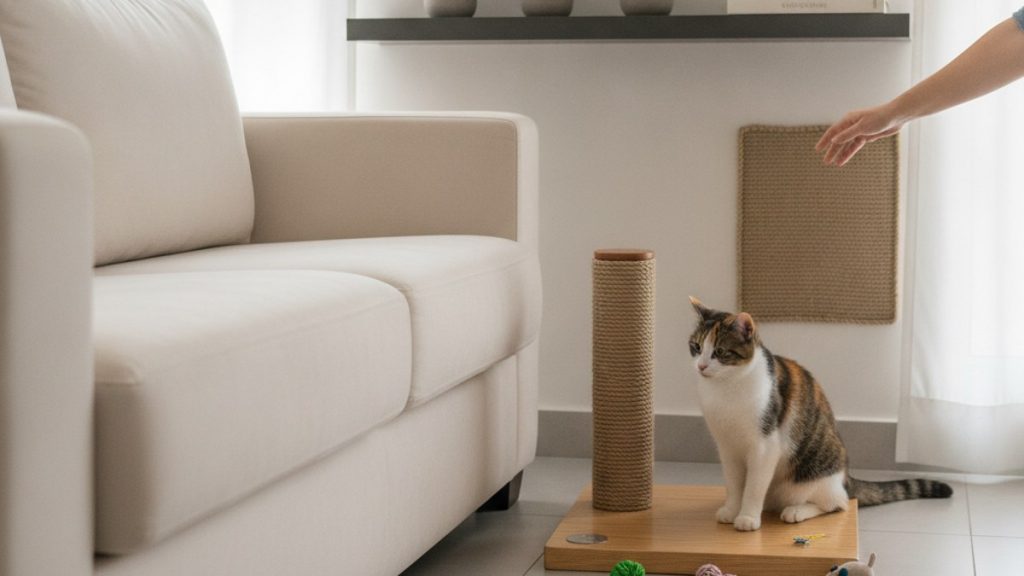
The key to good scratch management is to offer attractive and suitable alternatives before the cat feels the need to use the sofa. This means investing in quality scratching posts and, above all, positioning them strategically. There is no “best” universal scratching machine; preference varies from cat to cat.
Consider the diversity of materials. The sisal is a classic, loved by many for its rough texture and strength. But do not limit yourself to it: corrugated cardboard, carpet, wood (especially cedar or pine without chemical treatment), and even thicker fabrics can be attractive. The ideal texture allows the cat to “tiepatch the claws and pull them, performing the full scratching movement.
Vertical scratchers, like poles or trees, allow the cat to fully stretch, satisfying the need for stretching.Make sure that they are high enough that the cat, when stretching on its hind legs, can reach the top with the front claws. Horizontal (carpet, cardboard blocks) and inclined (ramps) scratchers are equally important, as some cats prefer to scratch in these positions. A scratching post shaped like “L” or “”
Stability is non-negotiable. A scratching post that tumbles or swings as the cat tries to use it will be quickly abandoned. Cats need to feel safe to lean on and apply force.Wide and heavy bases are ideal for vertical scratching.
As for positioning, think like a cat. Place scratchers in prominent and easily accessible places:
- Near the areas where the cat usually sleeps, as many like to scratch right when waking to stretch.
- At crossing points, such as corridors or near doors, to reinforce territorial marking.
- Next to furniture that the cat has already tried to scratch (or is scratching). The idea is to offer a superior and immediate alternative.
- In rooms where the cat spends most of its time, ensuring that there is always an option in sight.
To introduce a new scratching post, use positive reinforcement.Play with your cat near him, reward with treats when he interacts, and if he likes catnip, rub a little on the scratching post to make it even more inviting. Avoid forcing the cat's paws into the scratching post, as this can create a negative association.
Navigating the Deviation: Strategies to Protect Your Furniture
Even with ideal scratching posts, some cats may still insist on using the furniture. In these cases, behavioral management focuses on deflecting focus and making unwanted surfaces less attractive, while the appropriate options become irresistible.
Screams, sprinkles of water or any form of aggression do not teach the cat to stop scratching; they just teach it to be afraid of you or to scratch secretly when you are not around. Punishing an instinctive behavior generates stress and can lead to other behavioral problems, as well as shake the trust between tutor and pet.
To protect specific furniture, you can make them temporarily unpleasant to the touch. Thick plastic films, double-sided adhesive tape (the one that leaves no residue, specific for pets) or foil can be applied to the areas that the cat scratches.The texture and feel of these surfaces are usually aversive to cats. Some tutors use motion-activated compressed air sprayers, which release a harmless but frightening jet of air when approaching the furniture, but these should be used with caution not to make the animal excessively stressed or averse to enter the area.
When you catch your cat scratching a piece of furniture, do not scold it. Instead, gently redirect it. Take it and take it to a suitable scratching post, praising it and offering a snack if it interacts with it. Repeat this process consistently. Toys hanging from the scratching post or catnip can help attract interest. The key is to be patient and persistent. Over time, the cat will associate the appropriate scratching post with the reward and the unwanted furniture with the unpleasant feeling.
Another important tool is regular nail cutting. Keeping claws trimmed minimizes potential damage to furniture and people. This is a basic care that should be taught from puppy, if possible, to make the experience less stressful. If you do not feel comfortable to do so, a veterinarian or groomer can perform the cut.
When Professional Aid Is Necessary and the Legal Limits in Brazil
Although most scratch problems can be solved with proper behavioral management, there are situations where professional help is indispensable.If your cat's scratch becomes excessive, obsessive, or manifests suddenly with an unusual intensity, this may be a sign that something more serious is happening. Cats may scratch compulsively due to pain, anxiety, severe stress, extreme boredom, or even neurological problems.
In such cases, the first measure is to seek a general veterinarian to rule out any underlying health problems. If physical health is confirmed, the next step is to seek the guidance of a behavioral veterinarian (a veterinarian specializing in animal behavior) or an ethologist. These professionals have the knowledge to assess the cat's environment, its history and its personality, and develop an individualized management plan that may include environmental modification, more advanced positive reinforcement techniques, and in some cases, anxiety control medication.
It is essential to address an ethical and legal issue of utmost importance: the surgical removal of the claws, known as onicectomy (or “clawing”). In Brazil, onicectomy is expressly PROHIBITED by the Federal Council of Veterinary Medicine (CFMV) through Resolution n° 1,069/2014. This practice is considered an unnecessary and cruel mutilation, as it removes not only the nail, but also the distal phalanx (part of the bone) of the cat's finger. Onicectomy causes chronic pain, locomotion problems, imbalance and can lead to severe behavioral problems such as the sandbox and the cat loses its defense, sandbox.
In replacement of onycectomy, a legal and ethical alternative, although temporary, are nail covers (also known as “soft paws”). They are small vinyl or silicone tips that are glued on the cat's claws. They prevent the claws from causing damage to furniture and protect the skin of humans or other animals in play. The covers fall naturally with the growth of the nail and need to be replaced periodically. They are a viable solution for tutors who need extra protection while working in behavioral management or for cats with specific conditions that require this measure. However, regular nail cutting remains as the most basic and essential care practice.
In summary, feline scratch management is a continuous process of understanding, provisioning and redirection. Onicectomy is neither an ethical nor legal option in Brazil. Instead, investment in proper, properly positioned scratching posts and patience in redirection are the most effective tools to ensure that your cat can express their natural behavior in a healthy way and that their home remains intact.