Homemade toys for dogs and cats: elaboration and safety
Find out how to create fun and safe toys for your pets using materials you already have at home, saving money and strengthening the bond with them.
Far Beyond the Economy: The Real Value of Home-Made Toys
The idea of creating toys for dogs and cats at home often arises from the search for savings, a valid motivation in times of tight budget. However, reducing the making of a homemade toy to a mere financial issue is to underestimate its potential. In fact, the preparation of entertainment items for our pets offers a layer of control and customization that is rarely found in industrialized products.
The true purpose of a homemade toy transcends the cost. It lies in the opportunity to offer an object specifically adapted to the needs, size, temperament and level of destruction of your animal. It is an act of care, of direct involvement in the welfare of the pet, which allows tutors to select safe materials, free of potentially harmful chemicals and designed to last 'or to be discarded without guilt when the joke comes to an end. In addition, the simple activity of creating something with their own hands strengthens the bond between tutor and animal, as the object is imbued with intention and attention.
It is not just about “ that make”, but “how to make” and “o that avoid”. Safety is the cornerstone of any home toy project.A poorly made or improperly made item can, instead of entertaining, cause serious accidents such as choking, bowel obstructions or injuries.This article aims to demystify the creation of home toys by offering a practical and safety-focused guide so that you can enrich the life of your dog or cat consciously and responsibly.
Safe Materials and the Imperative of Attention: What to Use (and Not Use)
The choice of materials is the most critical step in the manufacture of homemade toys. It is not enough that something is at hand; it is essential that it is safe for oral contact and resistant to physical interaction of your pet. A good homemade toy stimulates and entertains without becoming a risk.
For **dogs**, which usually have a more powerful bite and the habit of gnawing, choose:
- **Sturdy fabrics:** Old cotton t-shirts, jeans (denim), towels and fleece blankets are excellent.They should be cleaned, without buttons, zippers or other adornments that can be swallowed.
- **PETS bottles clean:** Expired, without labels and with the lid well threaded (or removed if there is a risk of ingestion). The sound of the kneading can be very stimulating.
- **Wool rolls or paper towels:** To fill with snacks, creating a foraging challenge.
- **Natural cotton or sisal strings:** Only if they are very well braided and without loose wires that can be ingested. Ingestion of rope fibers can cause intestinal problems.
For **cats**, who love to hunt, scratch and interact with light textures:
- **Cardboard boxes:** They become scratchers, hiding places or mazes. They must be clean and free of chemical residues or clamps.
- **Balls of crumpled paper or aluminum foil:** Light and noisy, stimulate the hunting instinct.Supervise so that there is no ingestion of pieces.
- **Light fabrics:** Small cotton or fleece flaps, tied in pompom shape or used for filling with catnip.
- **Wash paper rolls:** Can be cut into rings, forming light toys for the cat to push and chase.
- **Feathers:** Make sure they are firmly attached to a toy stick, without risk of loosening and ingestion.
**What ABSOLUTELY NOT to use (and why):**
- **Small objects:** Buttons, beads, hair elastics, small bottle caps. These are risks of choking and gastrointestinal obstruction.
- **Wires, twine, sewing thread, wool yarn:** Extremely dangerous for cats and dogs. They can be ingested and cause serious problems in the digestive tract (the “linear foreign body”), requiring surgery.
- **Plastic bags:** Risk of suffocation for any animal.
- **Treated wood or wood chips:** They may contain toxic chemicals or fragment, causing injury to the mouth and digestive tract.
- **Aluminum or laminated paper (excess):** Although a foil ball may be a supervised cat toy, excessive consumption or consumption of larger pieces may be harmful.
- **Toxic materials:**Paints, non-toxic glues, cleaning products, batteries or any object with electronic components.
- **Toys with loose fill:** Unless it is tightly sealed and with a secure filler (such as catnip or pieces of fabric).
Prioritize food-grade materials or that you wouldn't mind if your pet accidentally ingested small amounts.Durability is crucial; a toy that easily falls apart isn't safe.
Crafting Fun: Practical and Simple Examples
With the right materials in hand, creativity can flow. Here are some practical ideas, focusing on simplicity and safety:
**For Dogs:**
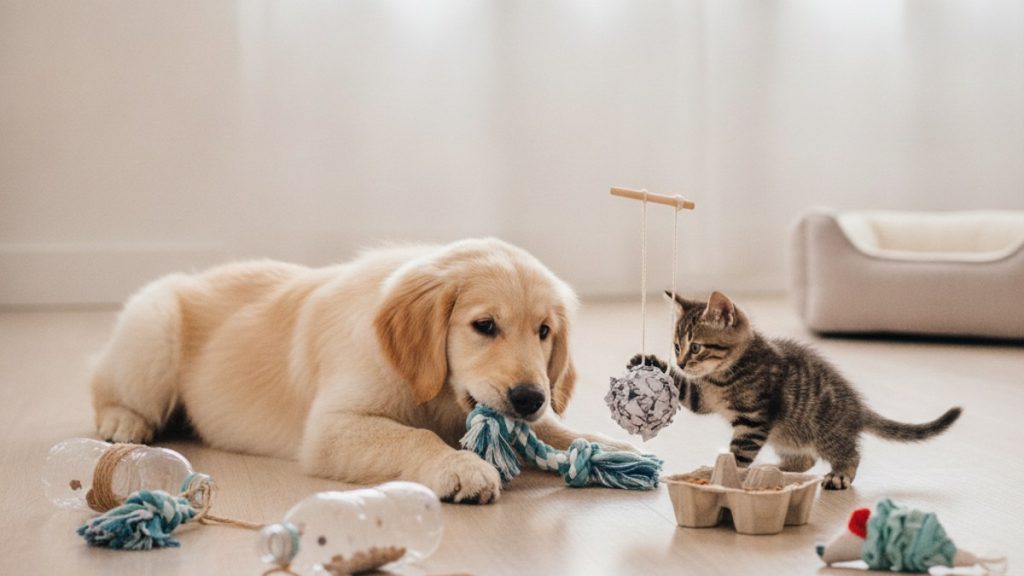
- **Woven Braided Rope:******Materials:**Two or three old cotton shirts or jeans. Scissors.****How to do:**Wash and dry the fabrics. Cut them into long strips (2-3 cm wide by 50-80 cm long, depending on the size of the dog and the desired toy). Join the three-strip tips with a firm knot. Trunk the straps to the end and end with another secure knot. Make sure there are no loose or shredded tips.* *They cable for dogs like: war and war.
- **Stuffed PET Bottle (Food Puzzle):*** **Materials:** A clean and dry PET bottle (preferably mineral water), dry snacks.****How to make:**Put small holes in the bottle (with scissors or a heated drill, with caution), large enough for snacks to fall when the dog handles it. Put the snacks inside. Remove the lid if the dog has the habit of biting it and there is a risk of destructive ingestion.**Benefit:*It reduces the speed of the reasoning.
**For Cats:**
- **Hunting Rod (with Feathers/Fabric):*****Materials:** A smooth and thin wooden rod (without splinters), a piece of resistant string (but not too long, to avoid entanglement), large feathers or fleece/felt strips.Atoxic glue (optional, for reinforcement).***How to do:***Brease the beard firmly at the tip of the rod. At the other end of the tutor string, tie or the feathers/tire fabric strips*Beat can be extremely prone to jump and make it.
- **Half Ball with Catnip:*****Materials:**A clean old sock (no holes), dry catnip (cat's herb). Line and needle or elastic.***How to do:**Fill the tip of the sock with a generous amount of catnip. Tie the sock tightly with a knot or sew the opening to create a small ball.****Benefit:* Catnip attracts many cats, providing moments of euphoria and play.
Creativity is the limit, but safety is the compass. Adapt ideas to your pet and always inspect the toy before each use.
Constant Surveillance and the Limit of Legality
A homemade toy, however well-made, is not an item of “place and forget”. Continuous supervision is an inseparable component of safety. Never leave your pet alone with a new toy or a homemade toy, especially if it has a tendency to destroy objects. Monitor the interaction, note if there are signs of parts detachment or deflection. At the slightest hint of damage, the toy must be inspected, repaired or preferably discarded immediately.
Regularly wash fabric toys if possible to remove dirt, bacteria and odors. Cardboard toys or PET bottles should be discarded and replaced when worn or soiled.
For those who think about going beyond personal use and marketing home toys, it is crucial to understand that the scenario changes radically. In Brazil, as in many other countries, the sale of products, even if handmade, implies responsibilities and regulations. Product safety standards, registration of materials used, legal formalization of the business (such as an Individual Microentrepreneur MEI or company), and compliance with consumer protection laws are just some of the requirements. There is no specific entity unique to toys for pets, but the manufacturer would be subject to general consumer laws and, depending on the material, regulations of other bodies to ensure that the product is safe and toxic business.
More Than Toys: The Power of Genuine Interaction
In the end, the value of a homemade toy lies less in the object itself and more in the experience it provides. The intention to create something for your pet, the careful choice of materials and the time dedicated to making are demonstrations of affection. More importantly, the toy becomes a bridge to interaction. No toy, no matter how elaborate or expensive, replaces the quality time, attention and play shared between the guardian and the animal.
A homemade toy is a tool to enrich the environment of your pet, stimulate your mind and body, and strengthen the affective bond. It is the opportunity to better know the tastes and habits of your companion, observing how he interacts with what you did with so much affection. Whether a cat chasing a hunting rod or a dog unraveling a puzzle of snacks, the real reward is in the joy and satisfaction that these moments of play and connection bring to both. Safety is the foundation; fun and the bond, the roof.