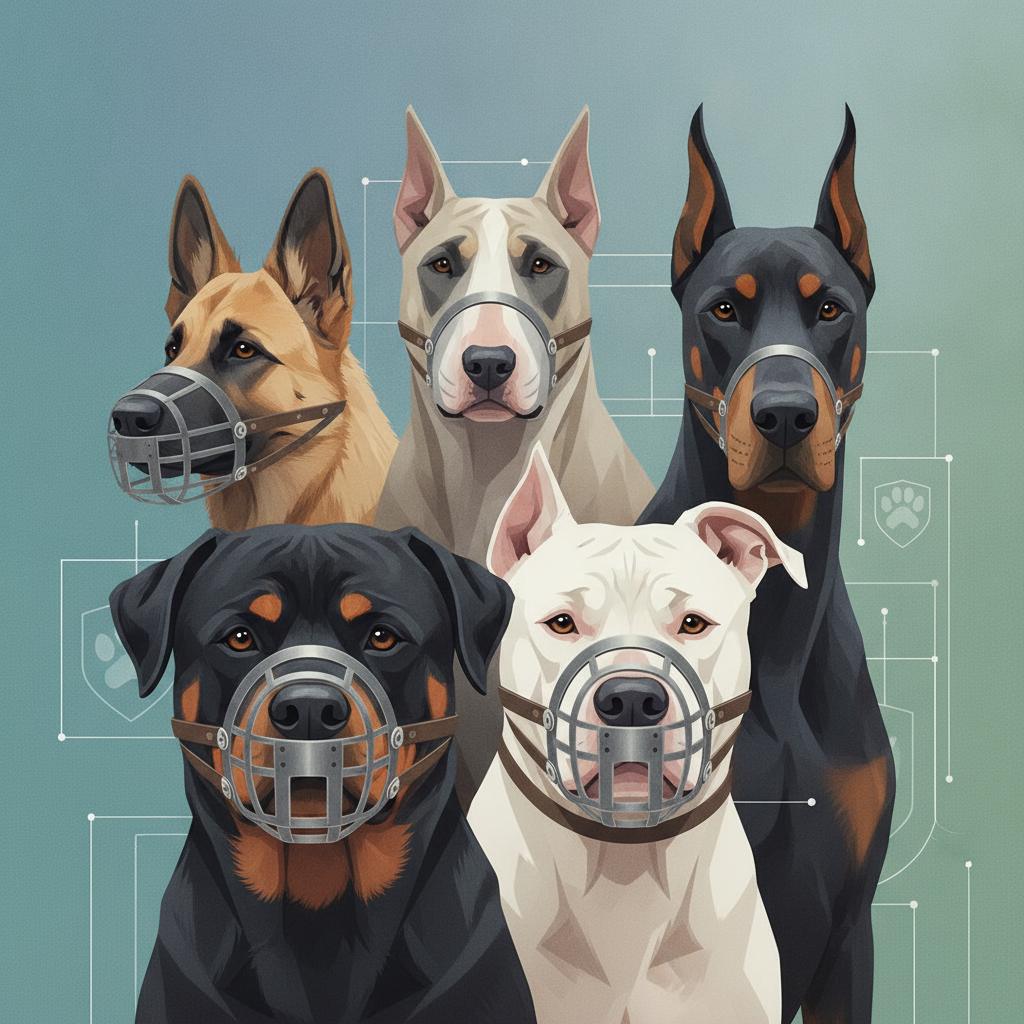
Compulsory muzzle: understand which breeds of dogs are included
The discussion about the use of muzzles in dogs is complex and often surrounded by misconceptions. For many owners, the idea of equipping their companion with a muzzle raises concerns about comfort, well-being and even social stigma.However, it is essential to understand that in certain contexts and for certain breeds, the muzzle is not an option, but a legal requirement. More than that, it is an important tool for public safety and for the welfare of the animal itself, ensuring that it can coexist harmoniously in various environments.
This in-depth guide aims to demystify Brazilian laws on the mandatory use of muzzles, specifying which breeds are often included, the additional criteria that can lead to their requirement and, crucially, how to choose and introduce the muzzle in a positive way. Our purpose is to provide clear and useful information so that you, responsible guardian, can navigate these rules with confidence, ensuring the safety of all and the comfort of your dog.
What the Law says: Understanding the Brazilian Law on Focinheiras
Unlike unified federal legislation, rules on the use of muzzles in Brazil are established at state and municipal levels. This means that the mandatory and included breeds can vary considerably depending on where you and your dog reside or transit.
Laws generally seek to balance the freedom of tutors with collective security.They are formulated based on characteristics of certain races (such as size, strength and, in some cases, bite history) and in specific situations of social interaction, such as the use of public transport or movement in areas of great agglomeration.
One of the most prominent examples is the legislation of the Sao Paulo State11,531, of November 11, 2003, regulated by Decree no. 48,533, of March 21, 2004, establishes clear guidelines for the conduct of dogs considered “potentially dangerous” in public places or in common use. Similarly, the State of Rio de Janeiro it has Law 4,597 of September 16, 2005, which also addresses the movement of dogs of certain breeds.
It is vital to emphasize that disobedience to these laws can lead to fines, seizure of the animal and, in more serious cases, even civil or criminal liability of the guardian, especially if there are incidents involving third parties. Therefore, the first and most important step is to check the specific legislation of your municipality and state.
Specific Breeds: Dogs Often Included in Legislation
The vast majority of state and municipal laws requiring the use of muzzles explicitly refer to a group of breeds that, due to their size, strength or behavioral characteristics (historical, although often stigmatized), are classified as “potentially dangerous” or require greater control. It is important to understand that this classification does not mean that all individuals of these breeds are aggressive, but rather that they have the physical ability to cause significant harm should an incident occur.
The breeds most commonly cited in Brazilian legislation include:
- Pit Bull's This category, often used comprehensively, usually covers breeds such as the American Pit Bull Terrier, the American Staffordshire Terrier and the Staffordshire Bull Terrier.
- Rottweiler Known for their strength and loyalty, Rottweilers are watchdogs and work dogs that often appear on must-do lists.
- Doberman Another breed with a strong guarding and protective instinct, the Doberman is athletic and imposing, also being included in many legislations.
- Fila Brasileiro: A large breed, developed in Brazil, with a reputation for guard and protective temperament, appearing in several regulations.
- Neapolitan Mastiff: Huge in size and robust in appearance, this dog is also often cited in specific laws.
The Question of Mestizos and Without Defined Race (SRD)
A common and pertinent doubt is about the crossbred dogs or SRDs. Most laws that mention specific breeds stipulate that the obligation also extends to dogs that, “by their size and behavior characteristics, fit the” definitions of the breeds cited or that are “derivados” of these. This means that an SRD dog with physical characteristics (size, musculature, head type) or behavioral (bite history, for example) similar to the breeds listed can be legally framed in the muzzle requirement. The interpretation in these cases may depend on the evaluation of authorities or even on the adoption of public perception, It is a matter of concern that is a more cautious aspect of concern.
Beyond the Breed: Other Criteria for the Obligation of the Focalheira
It is a misconception to think that the muzzle is required only for the “hazardous” breeds.Safety legislation and practices extend to other scenarios and criteria, aimed at protecting all involved. Ignoring these other factors can lead to unpleasant surprises and infractions.
Behavioral History of the Dog
Regardless of the breed, any dog that demonstrates a history of aggression or bites, whether against humans or other animals, may have the use of a muzzle required by judicial determination, animal control agencies or even veterinary/behavioral recommendation.In these situations, the muzzle acts as a crucial tool for behavioral rehabilitation and to ensure safety during the training and socialization process.It is an essential protective measure for the public and for the dog itself, preventing incidents from recurring.
Public Transport Standards
This is one of the most relevant points and it affects a large number of tutors. Public transport companies (bus, subway, trains, and even some transport applications) often have their own regulations, which can be more comprehensive than state or municipal laws on races. In many systems, it is common for the muzzle to be required for any medium or large dog, regardless of breed. In some places, even small dogs may have the muzzle requested in specific cases or for access to certain compartments. Before traveling with your pet, always check the rules of the transport company or the system you want to use. The rules are usually published on the websites or internal notices.
Regulations of Private Establishments and Condominiums
Many private establishments, such as malls, shops, parks and pet-friendly hotels, have the right to establish their own rules of access for animals. Although they often accept small dogs without restrictions, it is common to request the muzzle for larger dogs or for specific breeds, even if local law does not require it. Likewise, condominiums and residential complexes may have internal regiments that determine the use of the muzzle in common areas (elevators, halls, garages, party halls), aiming at the tranquility and safety of all residents. It is your duty as a tutor to consult and respect these norms before entering these spaces.
Choosing the Right Mouthpiece and Proper Training
The choice and introduction of the muzzle are as important as understanding the legal requirement. An improper or poorly introduced muzzle can cause discomfort, stress and even injury to your dog, in addition to compromising its effectiveness. The goal is for the dog to associate the muzzle with something positive and use it comfortably.
Types of Mouthwashes: Pros and Cons
- Basket Type Focal (Basket Muzzle):
- Description: Made of plastic, metal or silicone, it creates a” cage around the dog's snout.
- Pros: It allows the dog to open its mouth to pant (snack), drink water and even receive snacks through the cracks.It is the safest and most comfortable option for prolonged use, essential for temperature regulation, especially in the Brazilian climate.
- Cons: It can be seen as more aesthetically “aggressive”, and some metal models can be heavy.
- Ideal for: Long walks, public transport, reactive dogs that need a “area safe” in public, or to prevent bites without impeding vital functions.
- Strip/Nylon Mouthpiece (Soft Muzzle or Grooming Muzzle):
- Description: Usually made of nylon or fabric, it wraps around the dog's snout, keeping its mouth closed.
- Pros: Lightweight, compact and discreet.
- Cons: It prevents the dog from opening its mouth to pant, drink or vomit. It should not be used for long periods, as it can cause overheating and respiratory stress, as well as risk of vomiting. It is not effective to avoid certain bites, as dogs can slip their mouth out or bite with the front.
- Ideal for: Temporary and supervised use in situations such as rapid veterinary visits, grooming or brief procedures.
Guide to Choice and Positive Training
1. Correct Measurement: Measure your dog's snout at two points: the length (from the tip of the nose to the base of the snout, just below the eyes) and the circumference (in the widest part of the snout, near the eyes). The basket-type muzzle should allow a space of about 1 to 2 cm at the tip of the nose and be tight enough not to come out, but not tight. It is essential that the dog can open his mouth to pant.
2. Positive Association: Never put the muzzle to force. Present it to the dog positively. Start by letting it smell like a muzzle and reward with snacks. Then place snacks inside the muzzle so that it inserts the muzzle to reach them.
3. Increase Time Gradually: Start with just a few seconds, holding the muzzle and rewarding immediately. Increase the use time gradually, always associating with something good (play, caresses, short walks). The idea is that he associates the muzzle with things he likes.
4. Do Not Use As Punishment: The muzzle should never be used as a form of punishment, as this will create a negative association and make the acceptance process much more difficult.
5. Constant Monitoring: Especially for the first few uses, monitor your dog to ensure that he is comfortable and that the muzzle is not causing friction or preventing his breathing.
Common Mistakes and Honest Trade-offs
- Mistake 1: Ignoring Training. Believe that the dog will accept the muzzle naturally. Result: stress, resistance and negative association.
- Error 2: Choosing the Wrong Type. Using a nylon muzzle for long walks or warm weather, compromising the dog's ability to pant. Result: risk of overheating and malaise.
- Error 3: Inadequate Size. A very tight muzzle causes pain; a very wide one does not prevent the bite and can come off easily. Result: ineffectiveness and discomfort.
- Trade-off: Stigma vs. Security. Unfortunately, muzzle dogs can still generate a certain social stigma.However, public safety, legal compliance, and your dog's well-being (avoiding incidents) far outweigh any prejudice.
- Trade-off: Quick Solution vs. Behavioral Training. A muzzle is a legal risk and compliance management tool, not a cure for behavioral problems. A dog that needs a muzzle for aggressiveness still needs a training plan and behavioral modification with a qualified professional.
Frequently Asked Questions about Mandatory Mouthwashes
To clarify the most recurring questions, we have gathered the answers to some essential questions:
Q1: My dog is of a breed “included”, but has never shown aggression.I still need to use?
R: Yes, if the local law is *specifically breed* and you are in a public place where the law applies, your dog's individual temperament, although excellent, does not override the legal obligation. Legislation is based on the ability of certain breeds to cause significant harm, a preventive measure that aims at collective safety. It is a measure of legal compliance, regardless of your pet's particular history. Proper training of the muzzle ensures that your dog can comply with the law without stress.
Q2: Is the nylon muzzle suitable for riding?
R: Usually not for prolonged use or in situations where the dog can be panting.The nylon or strip muzzles prevent the dog from opening its mouth completely to pant (pantar), which is vital for the regulation of body temperature, especially in the hot climate of Brazil. Overheating is a serious risk. They are best suited for short periods and under supervision, such as visits to the veterinarian, grooming or brief procedures. For walks and use in public transport, the basket type muzzle is the safest and recommended for allowing proper breathing.
Q3: Does my dog need a muzzle inside the condo or in my yard?
R: Within your yard or private property, the muzzle is not required by law. In condominiums, the rules may vary. It is crucial to check the internal regulations of your condominium.Common areas, such as elevators, corridors, garages and party rooms, often apply rules similar to those of public spaces, or even more restrictive, requiring muzzle for dogs of specific breeds or large, aiming at the safety and comfort of all residents. The muzzle is a requirement for traffic in these areas.
Q4: Does muzzle use cause stress or trauma to my dog?
R: When introduced and trained correctly, through positive reinforcement and gradually, the muzzle does not cause trauma and can be accepted by the dog as part of its routine, as well as the collar. Stress and trauma arise from improper use: wrong size, forced imposition, or use of models that prevent the dog from breathing, drinking or moving comfortably. Good training makes all the difference, turning the experience into something neutral or even associated with positive events (such as walks).
Understanding and complying with the laws on the use of muzzles is a pillar of responsible ownership. More than a mere legal imposition, the muzzle is a tool that contributes to the safety of all humans and animals & animals & allows dogs of all breeds and temperaments to enjoy public spaces in a more integrated way. By informing yourself, choosing the right equipment and investing in positive training, you will be not only avoiding legal problems, but also promoting the well-being of your dog and harmony in social life. Remember, a conscious guardian is a guardian who cares, protects and prepares for all the needs.