Travel with dogs and cats: recommendations for safety
Planning the trip with your four-legged best friend ensures that the experience is safe, comfortable and full of unforgettable moments for everyone.
Travel with Dogs and Cats: A Conscious Journey to Safety
The decision to include dogs and cats in our trips has transformed the concept of holidays and walks, raising them to the status of family members who share all experiences. However, this integration, however desirable, carries with it an immense responsibility: the safety and well-being of animals. Far from being a mere whim, planning a trip with pets requires careful analysis, meticulous preparation and a deep understanding of the nuances that each mode of transport and destination imposes. This is not a guide to make the trip “easy”, but rather to ensure that it is, above all, safe and minimally stressful for everyone involved.
Traveling with an animal is not just transporting it from point A to point B; it is managing a complex ecosystem of health, behavior and environment. A pet exposed to an unknown scenario can manifest stress, anxiety, fear or, in extreme cases, develop health problems. Ignoring these variables is not only recklessness; it is putting at risk the life of the companion and the integrity of the trip itself. This article aims to demystify safety in travel with pets, offering a realistic and practical overview so that the adventure is memorable for the right reasons.
Preparation is the Soul of Safe Travel: No Improvisions
The safety of a trip with your pet begins long before you pack. The fundamental pillar is the veterinary consultation. A complete check-up is essential to attest the health of the animal and ensure that it is able to travel. This includes updating vaccines (such as rabies, mandatory for national and international transit, and multipurpose), vermifugation and control of parasites (ticks and fleas), which may vary according to the destination. Many veterinarians recommend microchipping as a form of permanent identification, especially useful in case of loss.
The health certificate, issued by the veterinarian, is the most important document for domestic travel, whether by car, bus or plane. It certifies that the animal is able to travel and free of contagious diseases. For air travel, each company has specific requirements for the validity of the certificate (usually 10 days before the flight) and other requirements, such as weight and dimensions of the transport box. For international destinations, the process is even more complex, requiring an International Veterinary Certificate (IVC) and sometimes laboratory tests and quarantines that require months in advance.
In addition to documentation, the preparation of the pet involves training and ambiance. Accustoming the animal to the transport box weeks before the trip, using it as a safe and comfortable place at home, can significantly reduce stress. Simulate small car journeys and accustom the pet to movement is also beneficial. Ideally, the animal should associate the transport box with a positive experience, with snacks and toys, and not to a punitive confinement. Do not neglect the identification collar with a plate that contains the pet's name and updated contact telephone. The pet's luggage should include water, usual food, bowls, continuous use medications, toiletries or first aid kit (toile items, toiletries, first aid).
Road Safety: Adaptation to the Mode of Transport
Each mode of transport presents different challenges and safety requirements.
Car Travel
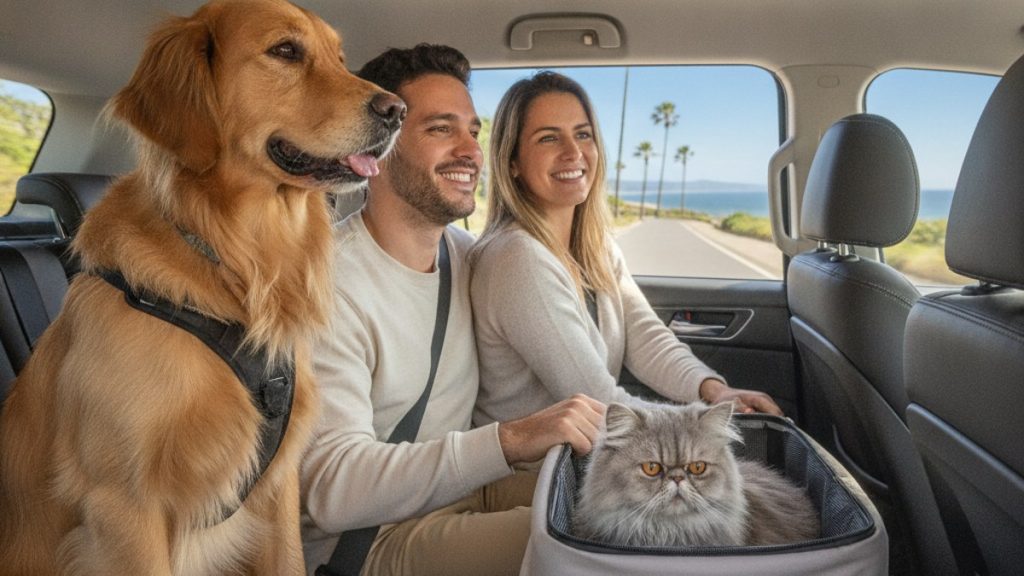
In Brazil, the Brazilian Traffic Code is clear: animals must be transported safely, without disturbing the driving or offering risk to passengers. This means that they can not travel loose in the vehicle, on the lap of the driver or between the front seats. The legal options are: transport boxes (or “carriage cages”) properly attached to the seat belt in the rear seat, or adapted seat belts that attach to the animal's chest collar, also in the rear seat. Transporting the pet irregularly can result in a fine and points on the driver's license, in addition to the risk of accidents.
During the journey, regular stops every two or three hours are essential for the pet to drink water, make their needs and stretch their legs (always with a guide!). Proper ventilation is crucial, and never, under any circumstances, leave the animal alone in the car, even for “only a few minutes”, especially on hot days, as the internal temperature can rise dangerously fast. Avoid feeding the pet large meals immediately before or during the trip to prevent motion sickness.
Airplane Trip
This is perhaps the most complex and stressful modality for animals. Rules vary dramatically between airlines, and the option to travel in the cabin (usually restricted to small pets that fit in a transport box under the forward seat) or in the cargo compartment needs to be evaluated with extreme care. Brachycephalic breeds (with a short snout, such as Pugs, Bulldogs, Persian Cats) are often refused by airlines for travel in the cargo compartment due to the high risk of respiratory problems. Sedation for flights is not recommended by most veterinarians and airlines, as it can lead to high-respiratory complications.
It is essential to book the transport of the pet in advance, as there is a limit of animals per flight. Check all the requirements of the airline, including the type of transport box (rigid or flexible, dimensions, ventilation) and the necessary documentation. For many animals, especially the largest that need to go in the cargo compartment, the flight can be a traumatic experience. Carefully weigh the need for travel versus the well-being of your pet.
Travel by Bus or Train
Regulations for transporting pets on road buses and trains are quite restrictive and vary by company and state legislation. Generally, only small animals in suitable transport boxes are allowed, and there is a limit of one or two pets per trip, with specific seats or in designated compartments. It is imperative to consult the transport company well in advance and confirm all documentation requirements, weight and size. Many companies charge an additional fee.Be prepared for a process that can be bureaucratic and limited.
Arrival at Destiny: Keeping the Guard High
Safety does not end upon disembarkation. Upon arrival at the destination, the pet will need time to acclimatize to the new environment. Keep it initially confined to a safe and familiar area (with its bed, toys, water and food) and gradually introduce it to the new spaces. Check the place to identify possible dangers: toxic plants, unprotected windows, access to cleaning products, exposed outlets or open gates. If the destination is a hotel or hostel “pet-friendly”, strictly abide by the rules of the establishment to avoid problems and ensure that future trips with pets remain an option.
Even in new environments, try to keep your pet's routine as much as possible, including feeding times and walks. On tours, the guide is your best friend; never let your pet loose in an unknown location. Try to identify a veterinarian or emergency clinic in the destination region before even leaving home. Having this information at hand can be crucial in case of unforeseen events. Remember that new environments can offer new smells, noises and stimuli that can generate stress or excessive curiosity, raising the risk of leaks or accidents. Constant supervision is vital.
What Is Not Really Worth It: An Honest Perspective
In a portal that values the relationship between pets and tutors, it is crucial to be honest about the limits. What is definitely not worth it is:
Risk the life of your pet for convenience: Transport him loose in the car to “economize” buying a belt or box, or opt for sedation without veterinary guidance for a flight he would barely stand. The economy or the momentary” “facility never justify putting the animal's life at risk.
Force the trip to a pet that does not adapt: Not every animal has the profile to travel. Very old animals, with chronic diseases, puppies not yet fully immunized, or pets with extremely anxious or fearful temperament, can suffer significant trauma on long trips or in very different environments. In these cases, a good pet-sitter or a hotel for reliable pets can be the best and most loving option.
Ignore previous research: Traveling without knowing the documentation requirements, the rules of the transport company, the destination restrictions or the weather conditions can result in huge inconveniences, from the impossibility of boarding to serious health problems for the pet.
Traveling to inappropriate destinations: Taking a thick-coated dog to a region of extreme heat without a cooling plan, or a cat who hates leaving home for a wild camp, is a recipe for suffering.
The decision to travel with a dog or cat is a serious commitment that requires planning, research and, above all, a deep respect for the welfare of the animal.When done with awareness, the trip can be an enriching experience; but without it, it becomes a dangerous burden for your furry companion.