Origins of the Jaguar XK120
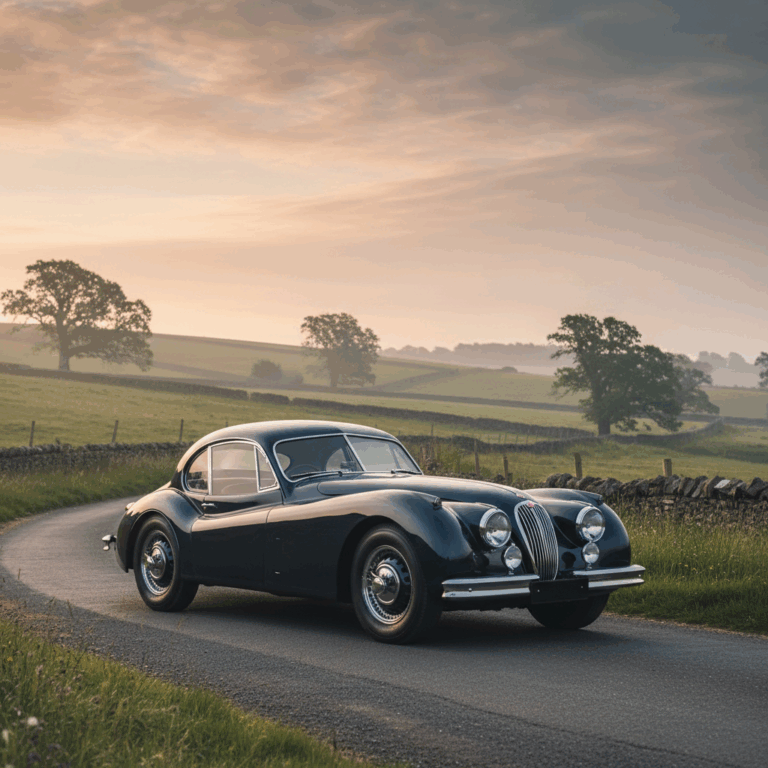
The Jaguar XK120 it marked the beginning of a British automobile legend after World War II. It was the first major sports car to redefine Jaguar engineering.
Presented at the London International Motor Show in 1948, this model emerged to showcase the new XK engine, an innovative engine designed for future sedans.
The urgency to showcase this engine led to the rapid creation of a two-seater sports car with a shortened chassis and handmade aluminum body, a unique combination of design and functionality.
Historical context and presentation
After rebranding as Jaguar, the brand sought to make an impact with its new inline six-cylinder engine in a competitive post-war market. The XK120 was presented as a surprise.
The model caused great expectations with aerodynamic lines and integrated fenders, unusual features for the time and which attracted worldwide attention.
The XK120 name reflects its ability to exceed 120 miles per hour, cementing it as the fastest production car of its time and a symbol of affordable luxury.
Design and initial development
The XK120's design combined elegant styling with advanced technology. Its aluminum body was manufactured manually, reflecting the dedication put into each initial unit.
The shortened chassis and lightweight structure sought to maximize dynamic performance. This approach made a notable difference compared to regular sedans.
William Lyons, founder of Jaguar, initially hesitated about production, but success in early presentations prompted mass production of the model.
Technical characteristics and performance
The Jaguar XK120 stood out for its XK engine, an advanced 3.4-liter inline six-cylinder engine that delivered 160 HP of power. This engine fused power and reliability.
Originally designed for sedans, it was masterfully adapted for the sports car, providing exceptional performance that propelled Jaguar to the global automotive elite. In addition, the XK engine is considered a technical icon, which would set the course for the brand's future engines.
XK engine and specifications
The 3.4-liter XK engine featured a double camshaft and a sophisticated design that optimized combustion and performance. Its architecture allowed high revolutions to be reached without suffering failures.
With a maximum power of 160 HP at 5750 rpm, this engine provided formidable acceleration for the time, capable of taking the vehicle to high speeds with great agility.
The combination of powerful engine and low weight thanks to the aluminum body allowed the XK120 to offer an excellent power-to-weight ratio, key to its success on the road and track.
Interesting fact
The XK engine not only equipped the XK120, but also powered other Jaguar models for more than 20 years, establishing itself as one of the most durable and prestigious engines in the industry.
Maximum speed and records
The name XK120 refers to its capacity to exceed 120 miles per hour, which was equivalent to an impressive 193 km/h by the end of the 1940s, a record among production cars.
Special versions of the XK120 reached speeds exceeding 130 mph (210 km/h) in track tests, evidencing the vehicle's advanced engineering and technical supremacy.
These achievements made it the fastest production car in the world during its launch, setting a new standard for British sports cars and making motorsport history.
Impact on the market and popularity
The Jaguar XK120 quickly became a global icon, not only for its speed but for offering luxury and performance at an affordable price compared to other European sports cars.
Its immediate success confirmed Jaguar's innovative vision and positioned the brand among the automotive elite, awakening passion in amateurs and professionals alike in different latitudes.
Thus, the XK120 not only set a trend but established a standard for sports cars, being a reference for design and technology in the post-war market.
Global reception and commercial success
After its presentation, the XK120 was received with enthusiasm in Europe, the United States and other key markets, conquering collectors, runners and the general public alike.
Its combination of attractive aesthetics and superior performance attracted high demand, making the model recognized as a symbol of status and performance.
Furthermore, its competitive price allowed various sectors to access motor sport, thus expanding the customer base and consolidating its commercial success worldwide.
Production and evolution of manufacturing
Initially handcrafted with an aluminum body, the XK120 soon underwent a transition to series production with steel bodies.
This change allowed manufacturing to be significantly increased, satisfying growing demand and facilitating its international distribution efficiently.
The evolution in production processes reflected Jaguar's maturity as a manufacturer, and laid the foundation for later models that would continue the brand's sporting tradition.
Legacy and meaning in Jaguar
The Jaguar XK120 established the foundations of an extensive sports car saga that defined Jaguar's identity. Its impact went far beyond a simple model, marking a unique style and philosophy.
Since its launch, it represented the perfect combination of elegance, performance and advanced technology, values that persist in Jaguar sports cars to this day.
Foundation of the sports saga
The success of the XK120 prompted the creation of its successors, such as the XK140 and XK150, which continued to expand the legacy of British sports cars with high technology and refined design.
This model started a line of cars that became icons of the brand. The commitment to the XK engine and sportiness defined Jaguar's technical and aesthetic identity.
The saga founded by the XK120 is the foundation that allowed Jaguar to maintain a privileged position in the sports car segment for decades.
Influence on the history of motorsports
The XK120 was not only commercially revolutionary, but influenced the evolution of motorsport, raising the level of engineering and design in post-war sports cars.
Its record speed and performance set new standards and inspired manufacturers and drivers to push technical and speed limits on circuits and roads.
This model remains a historical icon that reflects Jaguar's technological advancement and global reputation in motorsport.