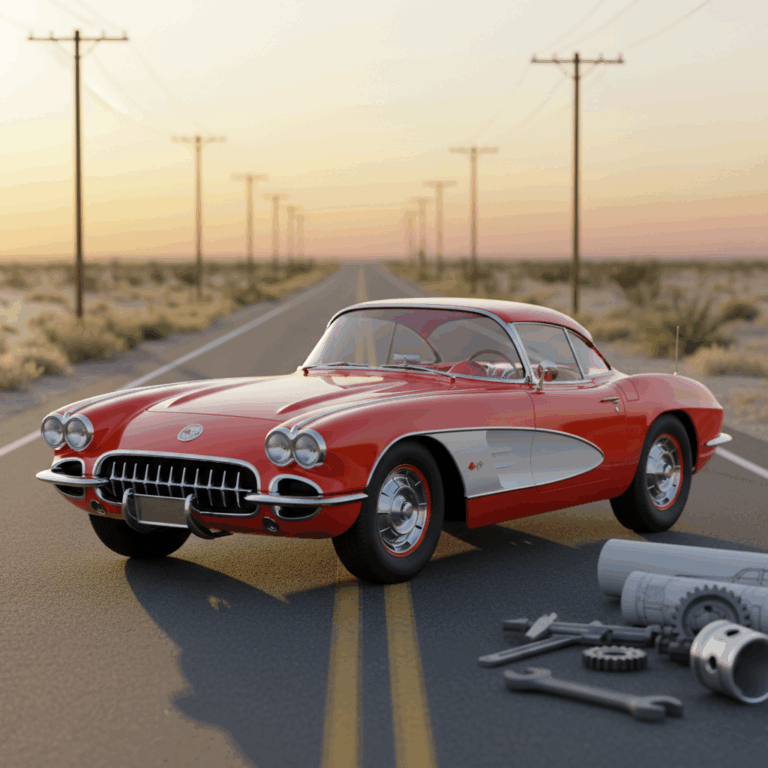
History and launch of the Chevrolet Corvette C1
The Chevrolet Corvette C1 was launched in 1953, marking the beginning of an icon of American sports cars. Its presentation revolutionized the automotive market of the time.
This model was born to compete with European sports cars, standing out for its innovative design and the use of fiberglass, something unusual at that time.
Its launch at the New York Auto Show was a key event that established the Corvette C1 as a promising vehicle and different from other models.
Presentation and context of the first Corvette in 1953
The debut of the Corvette C1 in 1953 reflected Chevrolet's ambition to create an American sports car capable of competing globally.
Its design was inspired by the EX-122 concept, which impressed at previous events and showed the potential the model would have in the market.
In a context where European cars dominated in sportiness, the Corvette presented a fresh proposal with an American approach.
This launch marked the beginning of a new era for Chevrolet, consolidating its commitment to innovation and competitiveness.
Original design and initial technical characteristics
The Corvette C1 presented a fiberglass body, a novelty that provided lightness and resistance to the vehicle.
Initially equipped with an inline six-cylinder engine and Powerglide automatic transmission, it offered basic technical features.
These elements reflected the intention to create an innovative but still evolving car, with great potential for future improvements.
Interesting fact
The fiberglass used in the Corvette C1 was an innovation that allowed for a more aerodynamic and lighter design, ahead of its time.
Technical evolution and improvements during production
During its production, the Chevrolet Corvette C1 experienced important technical advances that consolidated its position in the world of sports cars.
Mechanical improvements and adjustment in aesthetic details responded to the need to optimize performance and attract the competitive American market.
These advances were key to the growth and recognition of the Corvette C1, establishing solid foundations for future generations.
Introduction of the V8 engine and mechanical improvements
In 1955, Chevrolet incorporated a small-block V8 engine that revolutionized the performance of the Corvette C1, increasing power and response.
This mechanical improvement was essential for the Corvette to begin to truly compete with European sports cars, improving its acceleration and maximum speed.
In addition to the engine, components such as the suspension and transmission were updated, seeking to improve maneuverability and driving experience.
Aesthetic changes and design adjustments
Throughout its years of production, the Corvette C1 received design modifications that refined its image and functionality.
Details such as the front grille, taillights and instrument panel were adjusted to offer a more modern and attractive look.
These changes also facilitated improvements in the vehicle's aerodynamics and comfort, elements highly valued by owners.
Curiosity about design
The aesthetic evolution of the Corvette C1 included the adoption of brighter colors and interior combinations that increased its exclusivity and sporty style.
Challenges in sales and quality
Despite technical improvements, the Corvette C1 faced difficulties in its first sales, due to quality and market perception problems.
Initial buyers reported mechanical failures and durability limitations, which affected confidence in the model during its early years.
However, these difficulties motivated Chevrolet to implement stricter quality controls and continue perfecting the car.
Impact of the Corvette C1 on the automotive industry
The Chevrolet Corvette C1 revolutionized the industry with its pioneering use of fiberglass, marking a before and after in construction techniques.
Its innovative design and cutting-edge materials inspired other manufacturers to explore new possibilities in sports cars.
Additionally, the Corvette C1 set standards that influenced the evolution of aesthetics and functionality of American sports vehicles.
Innovation in automotive materials and design
The use of fiberglass in the Corvette C1 was a key innovation, offering a light and resistant body, something unusual at the time.
This technology enabled an aerodynamic design that improved performance and set trends in subsequent automotive manufacturing.
Furthermore, its structure combined style and functionality, emphasizing a modern approach that influenced the industry for decades.
Influence on the evolution of American sports cars
The Corvette C1 laid the foundation for the American sports car identity, driving the development of cars with more power and bold style.
Its arrival strengthened competition with European brands and motivated local manufacturers to innovate in performance and design.
This influence is reflected in how American sports cars evolved into iconic and highly valued models worldwide.
Legacy and relevance of the Corvette C1
The Chevrolet Corvette C1 set a precedent in the American automotive industry, leaving a legacy that influences sports cars to this day.
Its innovation in design and commitment to emerging technology positioned the Corvette as an icon of power and style.
This first Corvette not only defined a series of models, but also created a cultural symbol with strong social and commercial impact.
Harley Earl's role and distinctive design
Harley Earl, a pioneer of automotive design, was key in the creation of the Corvette C1, giving it a bold and distinctive style.
His vision integrated aerodynamic shapes and innovative materials, such as fiberglass, that marked a new era in design.
This innovative approach made the Corvette a benchmark, standing out for its sporty aesthetics and advanced technology for the time.
The Corvette as a symbol of power and prestige
Over time, the Corvette C1 transcended its role as a car to become an emblem of status and success in the United States.
Its association with power and prestige was consolidated thanks to its exclusive performance and design, which attract enthusiasts and collectors.
Today, the legacy of the Corvette C1 remains valid, being an icon admired for its history and its influence on automotive culture.