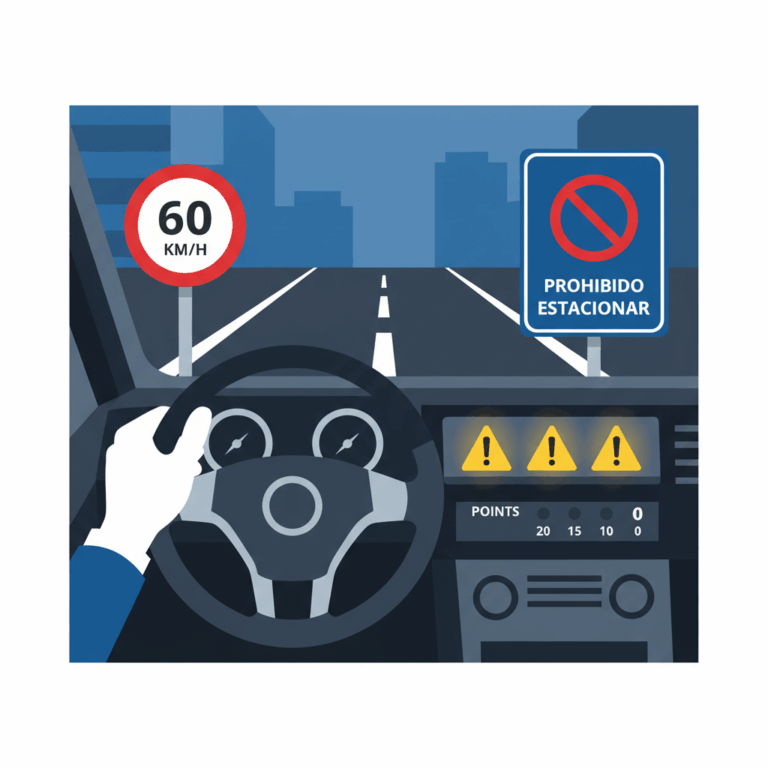
Basic operation of the point system
The points system is a mechanism designed to encourage a safe and responsible driving in Spain. Its objective is to reward good behavior and punish serious infractions.
Each driver starts with an initial balance of points that can increase or decrease depending on their driving behavior. This system seeks to raise awareness about the importance of respecting traffic rules.
Point management allows you to have clear control over the driver's history, encouraging them to avoid sanctions and maintain responsible behavior to avoid losing their license.
Starting points and progression
When obtaining a driving license for the first time, the driver starts with 8 points. If you avoid violations during the first three years, the balance increases to 12 points.
Driving without committing offenses for an additional period of six years raises the maximum to 15 points. This system rewards long-term responsibility.
The progression reflects the confidence given to the driver and motivates him to maintain a record without penalties, benefiting with a greater margin before losing his permit.
Relationship between infractions and loss of points
Each traffic violation is assigned a loss of points that varies depending on its severity, from minor to very serious. This works as a direct penalty.
For example, driving under the influence of alcohol or using a mobile phone can result in the loss of up to 6 points, seriously affecting the driver's balance.
When the points balance reaches zero, the driver loses his permit, having to take a course to recover it and demonstrate his ability to drive safely.
Types of violations and consequences
Traffic violations are classified as minor, serious and very serious, each with specific consequences for the driver. This categorization allows sanctions proportional to the risk generated to be applied.
The points system adapts to the severity of the violation, promoting liability behind the wheel. Knowing these categories helps drivers better understand possible point losses.
In addition, certain specific violations have a greater impact due to their potential danger, such as alcohol consumption or cell phone use while driving.
Minor, serious and very serious violations
Minor violations usually involve small fines and the loss of 1 or 2 points. These are offenses that do not put road safety at serious risk but must be corrected.
Serious violations pose a greater danger, with penalties of several points generally 3 or 4 points. These directly affect traffic safety and require immediate attention.
Finally, very serious violations, such as driving under the influence of alcohol or high speeding, lead to the loss of up to 6 points, reflecting its high danger.
Loss of points depending on severity
The number of points a driver loses depends on the category of the violation committed, with penalties increasing depending on the level of risk.
This system seeks to be fair and effective, further penalizing violations with the greatest potential to cause accidents and encouraging responsible behavior.
Furthermore, accumulating multiple penalties in a short time can accelerate the total loss of points and the consequent withdrawal of the driving license.
Specific cases: alcohol and cell phone use
Driving under the influence of alcohol is one of the most serious infractions, punishable by the maximum loss of 6 points due to the high risk it represents.
Using a mobile phone while driving also carries a severe penalty, contributing to distractions that increase the likelihood of accidents.
Both behaviors are strictly regulated to protect everyone on the road, and the penalty reflects the importance of maintaining attention when driving.
Procedure after losing all points
When a driver loses all points on his license, he is automatically deprived of his right to drive. This fact implies the temporary withdrawal of the license.
To regain the permit, the driver must follow a specific process, designed to ensure that he or she has acquired the necessary training to drive safely.
This procedure includes courses and tests that seek to reeducate the driver and promote responsibility behind the wheel, reducing the risk of recidivism.
Requirements to recover the permit
The driver must complete a 24-hour training course at an authorized driving school, which covers legal and practical aspects of road safety.
After completing the course, you must pass a theoretical test that verifies the knowledge acquired and understanding of traffic rules.
Once the evaluation is completed, the permit is restored, but the driver starts with an initial balance of 8 points, like any new headline.
Objectives and benefits of the points system
The main objective of the points system is to promote one safe and responsible driving, encouraging respect for traffic rules and reducing accidents.
This mechanism also benefits society by improving road safety, reducing the number of accidents and their social and economic consequences.
Promotion of safe driving
The system encourages drivers to maintain responsible behavior, since the loss of points implies sanctions and risks for your driving license.
By sanctioning dangerous behaviors, such as alcohol consumption or cell phone use while driving, a safer road environment is promoted for all users.
Additionally, awarding additional points to non-infringers encourages prudent and careful driving practices.
Incentives to maintain a good track record
Drivers who avoid violations can increase their points, reaching a maximum that reflects their excellent driving record.
These incentives encourage accountability and help create a culture of respect for rules, minimizing conflicts and accidents on the roads.
Likewise, maintaining a good balance of points gives the driver peace of mind, avoiding the loss of the license and the legal consequences that this entails.